During the first week of October 1851, Ezra Meeker and his wife Eliza Jane Meeker moved from their family’s farms in Indiana, four hundred miles west to Eddyville, Iowa, where they hoped to get a place of their own. Both had wanted to be farmers and when they were married earlier that year in May, made a resolution they would go to Iowa, get some land, and grow up with the country. [1]
We will go West and not live on pap’s farm. Nor in the old cabin, nor any cabin unless it’s our own, came the response, and so the resolution was made that we would go to Iowa, get some land and grow up with the country.
–Ezra Meeker (1906), The Ox Team or The Old Oregon Trail 1852-1906, pp. 15, 17
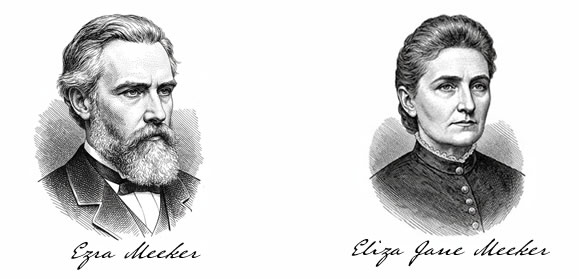
There were several important events that occurred after Ezra Meeker arrived in Eddyville that he never revealed in any of his books. The significance of these events cannot be understated, as they change the narrative we’ve been told about Ezra Meeker’ 1852 journey to Oregon.
The evidence for the events comes from Ezra Meeker himself, in a letter he wrote to his daughter, Carrie (Caddie) Osborne dated May 14, 1908. Meeker’s 1908 letter is part of the Ezra Meeker Papers, a collection of historical documents from Ezra Meeker’s lifetime, maintained and preserved by the Washington State Historical Society. Ezra Meeker’1908 letter provides a primary source record of the events that occurred after he arrived in Eddyville at the end of October 1851 through the first week of April 1852, when he and Eliza Jane decided to go to Oregon Territory. The Puyallup Historical Society at Meeker Mansion is aware of the contents of Ezra Meeker’s 1908 letter to his daughter as they were the ones who donated the letter to the Washington State Historical Society for inclusion in the Ezra Meeker Papers.
Ezra Meeker’s 1908 letter reveals that they weren’t the only Meeker’s to move to Eddyville that year. Ezra’s eldest brother John Valentine Meeker and wife Mary Jane Pence also moved from Indiana to Eddyville in 1851. After arriving in Eddyville at the end of October 1851, Ezra and Eliza Jane first stayed with Ezra’s uncle and aunt, Charles and Narcissa Meeker, who lived just across the Des Moines River from Eddyville in Monroe County. [2] [3]
Needing to earn some much-needed income, Ezra found work as a cook with the surveying expedition of Walter Clement of Eddyville, Iowa and Mr. Seavers of Oskaloosa, Iowa. Ezra’s eldest brother John Valentine Meeker also worked for Mr. Clement, as a flagman. When it came time for Ezra to leave town with the expedition, Eliza Jane refused to stay with Ezra’s uncle and aunt because the uncle was mean to his wife. To solve the problem, Ezra rented a 10×10 room for Eliza Jane at the home of a local minister named Spaulding. [2] [3]
Uncle Charly wanted your mother to stay with them but she wouldn’t do it. Uncle was cross to Aunt Narcissa and that settled it with your mother.
–Ezra Meeker letter to his daughter Caddie Osborne, 14 May 1908, Meeker Papers, Box 7, Folder 8C
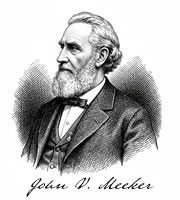 By December, Ezra was working at a surveyor’s camp near Kanesville in the far western part of the state. One day one of their flagmen, C. W. Vance, was sick, so Mr. Clement asked Ezra to fill in for him. Mr. Clement was so impressed with Ezra’s ability that he promoted him to a flagman. Meeker told his daughter, Carrie (Cassie) Osborne, in a letter he wrote her dated May 14, 1908, about his promotion to flagman and that he could plant the flag exactly on the line just like his eldest brother John. [3]
One day their flagman, Vance thought he was sick and Mr. Clement asked me if I would go for the day. I told him certainly I would. That ended my cooking for I beat Vance so bad flagging that Mr. Clement wouldn’t consent to give me up. There was no mystery about it to me but there was to him for time and again I would plant the flag exactly on the line. Uncle John (Ezra’s brother John V. Meeker) could do much the same.
–Ezra Meeker letter to his daughter Caddie Osborne, 14 May 1908, Meeker Papers, Box 7, Folder 8C
Within days after his promotion to flagman, Iowa’s bitter cold winter began to settle in. Ezra Meeker informed a very displeased Mr. Clement that he needed to get home to his wife Eliza Jane (who was now six months pregnant with their first child) and get into a place before the baby was born. Ezra and C. W. Vance made it back to Eddyville just before Christmas, nearly freezing to death. Ezra Meeker tells his daughter in his 1908 letter about why he quit his job with the surveying crew. [2] [3]
But when the first of January came I would go home. I wanted to get into a place before that important pending event should occur and Mr. Clement was very much displeased because I would go. It was terrible cold and some places 30 miles between cabins but I made it all right and Vance would go with me and came very near freezing to death.
–Ezra Meeker, Letter to his daughter Caddie Osborne, 14 May 1908, Meeker Papers, Box 7, Folder 8C
In late January 1852, Ezra and Eliza Jane rented a large 40-acre farm with a cabin three miles outside of Eddyville from a gentleman named John B. Gray. On March 4, 1852, at the cabin on their farm just outside of Eddyville, Eliza Jane gave birth to their first child, a son named Marion Jasper Meeker. [2] [3]
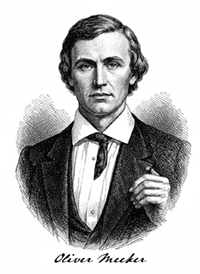 What Ezra Meeker didn’t know was, back home in Indiana at the family farm near Indianapolis during the winter of 1851, Ezra’s older brother, twenty-four-year-old Oliver Perry Meeker and a group of friends and neighbors were making preparations for a journey in the spring to Oregon Territory. The friends and neighbors were John and Jacob Davenport, David Wesley Ballard, Jane Ballard, and David’s younger brother, nineteen-year-old Martin D. Ballard. [4] [5]
While on his way to Oregon, Oliver made a stop near Eddyville, Iowa, the first week of April 1852, to visit his younger brother Ezra and wife Eliza Jane. The couple were living three miles outside of town on the forty-acre farm they began renting in January from John B. Gray. It was during this visit that Oliver persuaded Ezra and Eliza Jane to go to Oregon with him, and by the end of April they were on their way.
In his 1908 letter to his daughter, Ezra tells her about Oliver’s visit and the sudden decision he and Eliza Jane made to go to Oregon with him. [3]
But Oliver came along on the way to Oregon and so we very suddenly concluded to go too, and a partnership was formed with William Buck (Oliver had already made his arrangements with others before leaving home) and in two weeks’ time we were on the road.
− Ezra Meeker, Letter to his daughter Caddie Osborne, 14 May 1908, Meeker Papers, Box 7, Folder 8C
None of this was ever revealed by Ezra Meeker or the Puyallup Historical Society at Meeker Mansion in their various writings. In the first book Ezra Meeker wrote about his 1852 journey to Oregon, Pioneer Reminiscences of Puget Sound: The Tragedy of Leschi, published in March 1905, Meeker told readers the following instead.
But let us now consider the start and what happened.
“Do you think it safe to prepare for the trip?” This question was asked in a rather hesitating manner, as though the speaker felt it was hardly proper at the time to make such an inquiry of the person addressed.
“Why, yes; I think so. Baby will be three weeks old tomorrow, and it will take three weeks to get ready. I think it will be all right, don’t you?”
“Just like a woman,” I said, “to answer one question by asking another; but I think that settles it, and we will go to Oregon this year”
This little talk took place in a small cabin near the Des Moines River, in Iowa, with a good deal more of like kind, between the little wife and young husband, the writer of this story, during the first week of April, 1852
–Ezra Meeker (1905), Pioneer Reminiscences of Puget Sound: The Tragedy of Leschi, pp. 6, 7
The Puyallup Historical Society at Meeker Mansion and Wikipedia editor Gary Greenbaum published their own version and timeline for the same events.
In October 1851, the couple set out for Eddyville, Iowa, where they rented a farm. Ezra, working in a surveyor’s camp, decided that he did not like Iowa’s winters—a prejudice shared by his pregnant wife. Reports were circulating through the prairies about the Oregon Territory’s free land and mild climate. Also influencing the decision was the urging of Oliver Meeker who, with friends, had outfitted for the trip to Oregon near Indianapolis, and had come to Eddyville to recruit his brother. Ezra and Eliza Jane Meeker vacillated on the decision, and it was not until early April 1852, more than a month after the birth of their son Marion, that they decided to travel the Oregon Trail.
–Puyallup Historical Society at Meeker Mansion, Meeker Mansion Museum, Ezra and Eliza Jane Meeker, Migration to Oregon Territory, https://www.meekermansion.org/our-story-1
–Gary Greenbaum, Wikipedia, Ezra Meeker, Migration to Oregon Territory (1852), https://en.wikipedia.org/wiki/Ezra_Meeker
The facts from the historical evidence do not support nor corroborate the claims made by the Puyallup Historical Society at Meeker Mansion and Gary Greenbaum.
- The farm wasn’t rented until late January 1852, several months after Ezra and Eliza Jane arrived in Eddyville.
- There is no mention by Ezra Meeker, in any of the books he wrote, that he and Eliza Jane had heard that the land in Eddyville would be free. What Ezra Meeker did tell readers in his second book about his decision to go to Oregon in 1852, after changing the story he told readers in his first book, was the following
I vowed then and there I did not like the Iowa climate, and the Oregon fever was visibly quickened. Besides, if I went to Oregon the government gave us 320 acres of land, while in Iowa we would have to purchase it,—at a low price, to be sure, but it must be bought and paid for on the spot.
–Ezra Meeker (1906), The Ox Team or the Old Oregon Trail 1852-1906, p. 21
- Ezra and Eliza Jane did not vacillate on any decision to go to Oregon. It was a decision that was made suddenly when Oliver appeared while on his to Oregon. Ezra Meeker told his daughter in his 1908 letter that it was a sudden decision.
But Oliver came along on the way to Oregon and so we very suddenly concluded to go too, and a partnership was formed with William Buck (Oliver had already made his arrangements with others before leaving home) and in two weeks’ time we were on the road.
− Ezra Meeker, Letter to his daughter Caddie Osborne, 14 May 1908, Meeker Papers, Box 7, Folder 8C
- The inference that Ezra and Eliza Jane decided to travel the Oregon Trail is ludicrous. The first 700 miles they travelled after pulling out of Eddyville, Iowa was along the Mormon Trail. The Oregon Trail was 200 miles to the south where it started in Independence, Missouri. The Mormon and Oregon Trails met at Fort Laramie in present day Wyoming, and it was from there, nearly three months after leaving Eddyville that Ezra Meeker began travelling along the Oregon Trail.
In his first book about his 1852 journey to Oregon was Pioneer Reminiscences of Puget Sound, The Tragedy of Leschi, published in March 1905, Ezra Meeker provided good insight into what was important to him at that time, and it wasn’t the Oregon Trail. In fact, Ezra Meeker gave little importance to his 1852 journey to Oregon, writing just a few brief pages about the entire five-month, 2,000-mile journey in the books’ foreword. Not once did he mention he had travelled the Oregon Trail, nor do the words “Oregon Trail” appear anywhere throughout the entire book. Instead, Meeker refers to it simply as “the trip across the plains”.
The trip across the plains has been so often written that it would seem the whole ground has been covered, though from start to finish it was pioneer life in dead earnest. Nevertheless, the after-experience would seem incomplete without some mention of how we got to the pioneer field of the farther West, and a little of the experience on the way.”
−Ezra Meeker (1905), Pioneer Reminiscences of Puget Sound, The Tragedy of Leschi, pp. 5-8
It would be a couple of years after Pioneer Reminiscences of Puget Sound, The Tragedy of Leschi was published that Ezra Meeker would even begin to write about the Oregon Trail in any of his books.
Had it not been for Oliver’s visit during the first week of April, Ezra Meeker would never have gone to Oregon in 1852. There were no preparations made over the winter for a five-month journey to Oregon in the spring. No food was prepared, they had no supplies, they had no wagon, and they had no stock animals to pull a fully loaded wagon 2,000 miles across the Great Plains and over two mountain ranges to get to Oregon. And if Ezra Meeker had intended on going to Oregon in the spring of 1852, why did he rent such a large farm in late January?
Eliza Jane spent the rest of April preparing food for the five-month journey across the Plains, while Ezra and his friend William Buck outfitted a wagon and purchased two yoke of oxen and three cows. While out gathering supplies on April 14th, Ezra and Buck came across a family struggling to get their wagon up the muddy east bank of the Des Moines River near Ezra’s farm. They were the McAuley children from Mt. Pleasant, Iowa, Thomas, age 22, Eliza Ann, age 17, and Margaret McAuley, the eldest at age 28, who were on their way to California to be with their father. The McAuley’s would travel across the Great Plains with the Meeker party and became good friends with Ezra Meeker. Eliza Ann kept a diary of her journey to California which provides a primary source record for the events that occurred. Eliza Ann made the following diary entry on April 14, 1852 of the chance meeting her family had with Ezra and Buck. [2] [6]
Roads very bad. In one place we had to double teams, take one wagon ahead a mile or so and then return for the other wagon. While struggling through the mud we were overtaken by two men from Eddyville, Meeker and Buck, who told us they intend to start in a few days for Oregon. We camped at the foot of a bluff about a mile from Eddyville.
–Eliza Ann McAuley, Diary entry made during her journey to California, April 14, 1852
The McAuley children stopped and camped a couple miles outside of Eddyville on April 16, 1852 and spent the next two days grazing their stock. While they were there, they were approached by a Mr. and Mrs. Slater who asked if they could join them on their journey west. This delayed the McAuley’s while the Slater’s readied their wagon. [2]
1852 – Journey to Oregon Territory
On April 24, 1852, Oliver Meeker, Ezra Meeker, Eliza Jane Meeker, Marion Meeker, and William Buck set out from Eddyville, Iowa by ox-team and wagon for Oregon Territory. Eliza Ann McCauley made the following entry in her diary.
This evening the men who overtook us in a mud hole near Eddyville came to our camp for milk. They are Mr. Buck and the two Meeker brothers, one of them having a wife and a six weeks old baby. They started today.
–Eliza Ann McAuley, Diary entry made during her journey to California, April 24, 1852
We know from Ezra Meeker’s 1908 letter to his daughter that Oliver visited him at his farm just outside of Eddyville during the first week of April 1852. We also know from Eliza Ann McAuley’s April 24, 1852 diary entry that Oliver was with Ezra Meeker when they started their journey to Oregon that day. Instead of telling readers the truth about Oliver visiting him at his farm, and travelled with him across Iowa to the Missouri River, Ezra Meeker lied and wrote the following.
Of the trip through Iowa little remains to be said further than that the grass was thin and washy, the roads muddy and slippery, and the weather execrable, although May had been ushered in long before we reached the little Mormon town of Kanesville (now Council Bluffs), a few miles above the place where we were to cross the Missouri River. Here my brother Oliver joined us, having come from Indianapolis with old-time comrades and friends. Now, with the McAuley’s and Oliver’s party, we mustered a train of five wagons.
Ezra Meeker (1922), Ox-team Days on the Oregon Trail, World Book Company, Yonkers-on-Hudson, pp. 24, 25
From Eddyville, Iowa, the Meeker/McAuley wagon party travelled along the Mormon Trail to the Missouri River at Kanesville, Iowa (present day Council Bluffs). It was at the Missouri River that Oliver’s friends from Indiana, John and Jacob Davenport, and neighbors, David Wesley, Jane Ballar, and Martyn D. Ballard met up.
Eliza Ann McAuley made the following diary entry.
Got to Kanesville, four miles from the Missouri river about noon. After a short delay we went on to the river and camped as near the ferry as we could get. There are thousands of wagons waiting to be ferried over.
–Eliza Ann McAuley, Diary entry made during her journey to California, May 10, 1852
After crossing the Missouri River into Nebraska on May 18, 1852, they continued west along the Mormon Trail, travelling on the north side of the North Platte River. The wagon party consisted of the following
- Davenport wagon – John Davenport, Jacob Davenport, and Oliver Meeker
- McAuley wagon – Thomas McAuley, Eliza Ann McAuley, and Margaret McAuley
- Meeker wagon – Ezra Meeker, Eliza Jane Meeker, Marion Meeker, and William Buck
- Ballard wagon – David Wesley Ballard, Jane Ballard, and Martyn D. Ballard
- Cheney wagon – Winthrop Cheney and Merrick Cheney
When the party was near Fort Kearney, Nebraska, Oliver became seriously ill, likely from cholera. Ezra Meeker thought it best that they stop until Oliver was well enough to continue. The Ballard family, and the McAuley children, however, would not wait and instead continued on their way west. The Davenport brothers refused to leave their sick friend remained, as did Ezra’s friend, William Buck.
After four days of nursing Oliver back to health and well enough to continue, the Davenport/Meeker party resumed their journey west along the Mormon Trail. Around July 1, 1852, they reached Fort Laramie in present day Wyoming at the point where the Oregon and Mormon Trails met. It was at Fort Laramie, more than two months after leaving Eddyville, that they were now travelling along the Oregon Trail.
The wagon party continued west by themselves, crossing the Rocky Mountains around the 8th of July, and caught up with the McAuley children on July 10, 1852. Eliza Ann made the following entry in her diary.
Camped near a pine grove ten miles from lost River. Just at dusk our old traveling companions Buck and the Meekers came up and camped with us. We left them on the Platte River and have not seen them since. Ezra has been very sick with the mountain fever, but is better now. O. P. (Oliver Perry Meeker) has also been sick, but is now about well. They report a great deal of sickness back.
–Eliza Ann McAuley, Diary entry made during her journey to California, July 10, 1852
They would travel together with the McAuley’s for another week until reaching Big Hill in present day eastern Idaho where they parted ways for the last time. The McAuley children along with Ezra’s friend, William Buck, took the trail to California, and the Meeker’s and Davenport brothers took the trail to Oregon.
Oregon Territory
On September 20, 1852, after a five-month, 2,000-mile journey across the Great Plains by ox-team and wagon, the Davenport and Meeker wagon party reached The Dalles in Oregon Territory. At The Dalles Ezra Meeker bought passage on a riverboat for himself, Eliza Jane, and baby Marion, taking them down river to Portland and abandoning his wagon at. Oliver and the Davenport brothers meanwhile, continued their journey to Portland over land, taking Ezra’s stock animals and belongings with them. [7] [8]
The wagon was one of the most important possessions that a settle had. It provided safety and protection during the journey to Oregon and would continue to do so once they arrived. There is no plausible reason for Ezra to abandon his wagon at The Dalles and Oliver and the Davenport brothers not to take it with them other than it was not properly maintained and was broken beyond repair.
On September 29, 1852 Oliver Meeker and the Davenport brothers arrived in Portland, a few days ahead of Ezra and his family. One of the first places they likely visited was the local land office where they could obtain information and maps where public land was still available in the territory they could stake as a claim. Ezra, Eliza Jane, and baby Marion arrived in Portland on the evening of October 1, 1852. There to meet them was Oliver, who had secured a place for them to stay at a local boarding house.
In his first book about his 1852 journey to Oregon, Pioneer Reminiscences of Puget Sound: The Tragedy of Leschi, Ezra Meeker wrote the following about his arrival in Portland.
My brother, Oliver, who had crossed the plains with me a noble man and one destined, had he lived, to have made his mark- came ahead by the trail. He had spied out the land a little with unsatisfactory results, met me and pointed the way to our colored friend’s abode. We divided our purse of $3.75, I retaining two dollars and he taking the remainder, and with earliest dawn of the 2nd found the trail leading down the river, searching for our mutual benefit for something to do.
–Ezra Meeker (March 1905), Pioneer Reminiscences of Puget Sound, The Tragedy of Leschi, p.27
What Ezra Meeker neglected to tell readers was that when Oliver left, he left with his friends from Indiana, John and Jacob Davenport. And they knew exactly where they were going, to the town of St. Helens where workers were needed to help construct docks along the Columbia River for the Pacific Mail Steamship Company, the region’s dominant export shipping company at the time.
In St. Helens Oliver found work managing a hotel filled with over sixty workers. Oliver sent a letter to Ezra who was still in Portland telling him about the job and that there was work for everyone in St. Helens. Oliver asked Ezra in the letter if he should send him some money.
St. Helens, October 7th, 1852
Dear Brother: Come as soon as you can. Have rented a house,
Sixty boarders; this is going to be the place.
Shall I send you money?
O. P. M.
–Ezra Meeker (1905), Pioneer Reminiscence of Puget Sound: The Tragedy of Leschi, p. 27
Ezra had found work in Portland loading cargo on a ship that was bound for San Francisco when he received the letter from Oliver. As soon as the work completed Ezra, Eliza Jane, and baby Marion joined him in St. Helens.
What happened to the Davenport brothers you may be wondering. Ezra gave the following explanation in his book The Ox Team or the Old Oregon Trail published in October 1906.
Of the two Davenport brothers, Jacob, the youngest, took sick at Soda Springs, was confined to the wagon for more than eight hundred miles down Snake River in that intolerable dust, and finally died soon after we arrived in Portland.
John, the elder brother, always fretful but willing to do his part, has passed out of my knowledge. Both came of respected parents on an adjoining farm to that of my own home near Indianapolis, but I have lost all trace of them.
–Ezra Meeker (1906), The Ox Team or the Old Oregon Trail, p. 68
Jacob Meeker actually died soon after reaching St. Helens on October 12, 1852 and was buried in one of the town cemeteries. Ezra Meeker knew where John Davenport was, he was in St. Helens with Oliver. [9]
In early January 1853, construction on the docks was suspended and the workers were let go. The Hotel emptied and Oliver was out of a job. It was time to move on. Oliver Meeker, John Davenport, Ezra Meeker and his family loaded the wagon, their belongings and the stock animals on a ferry at St. Helens taking them to the opposite side of the Columbia River.
Kalama – Ezra Meeker’s First Land Claim
After crossing the Columbia River to the opposite, they headed north for about thirty miles to a location along the Columbia River John Davenport had marked on his map from the land office. Satisfied with the land, John Davenport staked his land claim about the 20th of January 1853. On February 12, 1853 John Davenport filed a donation land claim under the 1850 Donation Land Claim Act for 160-acres along the east bank of the Columbia River described as Section 7 T6N R1W 7 Cowlitz County, Section 17 6N R1W Cowlitz County, and Section 18 T6N R1W Cowlitz County. [10]
At the same time John Davenport staked his land claim, Ezra Meeker staked his first land claim, a fifteen-acre squatter’s claim taken under the Preemptive Land Act of 1841, located on the south boundary of John Davenport’s donation land claim. On the same day John Davenport filed his land claim, February 12, 1853, Ezra Meeker swore an oath at the land office affirming he was a citizen of the United States and filed his squatter’s claim that is described as Section 17 6N R1W Lot/Tract 1 Cowlitz County. [11]
In his 1921 book Seventy Years of Progress in Washington, Ezra Meeker described in great detail why he took the squatters claim, where it was located, the condition of the land, and the flood that soon occurred after he claimed it. [12]
We had taken this squatter claim from sheer necessity to secure a place where I could provide a roof over our heads and shelter from the storms then prevailing (January 1853), not because the location suited us; it was far below the ideals pictured in our imagination when preparing to leave Indiana in search of a Western home. We could not go further at the time. The trip across the plains with the ox and cow team had exhausted our scant accumulations, and so with cheerful submission to necessity, the claim was taken, the cabin built and clearing land begun.
The cabin stood about a hundred yards back from the river, just above the river bottom and on the rather steep slope of a solid, rocky bank. The site upon which this cabin stood is but a little over a stone’s throw from where the Northern Pacific Railroad depot at Kalama now stands. The cabin has long since disappeared, but I can yet identify the spot upon which it stood.
Soon after, a dire calamity overtook the pioneers of the up-river region. The snow melted rapidly, accompanied by warm rains; the floods came; the Columbia River became a vast field of driftwood, parts of houses, hay stacks, lumber, sawlogs, in a word, something of all kinds of property imaginable.
We, (when I say we now I mean myself, brother and an Indiana neighbor boy) instantly sailed out in our small boat, catching saw logs and towing them into a place of safety, working even by moonlight as well as all day — no eight or five hours a day there. When the flood subsided, we tackled giant trees that stood near the water’s edge and hand logged for a month to supplement our drift logs, when lo and behold, we finished with Eight Hundred Dollars in our pockets−Ezra Meeker (1921), Seventy Years of Progress in Washington, Allstrum Printing Company, Tacoma, WA., pp.15, 17
The Indiana neighbor boy Ezra Meeker was referring to was John Davenport, and the brother was Oliver Meeker.
In early May, 1853, unhappy with the squatters he had taken, Ezra Meeker decided to go with his brother Oliver exploring Puget Sound in search of a better location. Ezra Meeker wrote about his dissatisfaction of his choice of land and the decision to go with Oliver in his 1921 book Seventy Years of Progress of Washington.
I had practiced deceit with my wife in assuming a cheerfulness I did not feel; I came to know that she on her part, was doing the same thing; but this could not go on always, so one day we made a confession, whether manly or womanly or not, turned loose our disappointment in tears and soon felt the better for it. A week after the “confession,” accompanied by my brother Oliver, we struck the trail for Puget Sound.
Ezra Meeker (1921), Seventy Years of Progress in Washington, Allstrum Printing Company, Tacoma, WA., p.18
After a month paddling around Puget Sound, Ezra decided on a tract of land on McNeil Island. But there was a problem. Ezra Meeker couldn’t take another land claim until his squatter’s claim was no longer active on the rolls at the land office.
Under the Preemption Act of 1841, settlers taking a claim were required to live on the land and make improvements, such as building a cabin or a home. They were also required, at the end of twelve months from the date of settlement, pay to the land office $1.25 for each acre of land claimed. The land wasn’t free land. Once the required fee was paid, the settler’s name would be removed from the active rolls and the federal government would issue a land patent giving the settler clear title to the land. The land claim would remain active on the rolls until the required fee had been paid, or twelve months from the date of settlement, whichever occurred first.
nor hath he or she settled upon and improved said land to sell the same on speculation, but in good faith to appropriate it to his or her own exclusive use or benefit; and that he or she has not, directly or indirectly, made any agreement or contract, in any way or manner, with any person or persons whatsoever, by which the title which he or she might acquire from the Government of the United States.
—Preemption Act of 1841, 27th Congress, Ch.16, 5 Stat. 453 (1841), CHAP. XVI —An Act to appropriate the proceeds of the sales of the public lands, and to grant pre-emption rights., Sec. 13
Settlers couldn’t just run around the territory taking another land claim because they made a bad decision and were unhappy with the first claim they made. The Preemption Act of 1841 made sure of that. Ezra Meeker made a promise to the Government of the United States, and until that promise was fulfilled or the twelve months had expired, Ezra Meeker couldn’t take another land claim.
Afraid someone would come along and preempt the land on McNeil Island and claim it as their own, Oliver agreed to file a squatters claim on behalf of his brother. During the first week of June 1853, Oliver and Ezra went to the land office in Olympia, and Oliver Meeker filed a squatters claim for the land on McNeil Island. This gave enough time for Ezra Meeker’s name to be removed from the active land claim rolls for the squatters claim at Kalama.
Oliver returned to Steilacoom where he found work. Ezra Meeker returned to his claim at Kalama to bring his wife and child back to McNeil Island, abandoning his squatters claim. In March 1854, twelve months from the date Ezra Meeker began settlement on the squatters claim at Kalama, the Surveyor General’s office removed the claim from the active roll, returning it to the public lands.
In their version of Ezra Meeker’s history, the Puyallup Historical Society at Meeker Mansion and Wikipedia editor Gary Greenbaum published the following false and inaccurate account of Ezra Meeker’s squatters claim.
Oliver remained on the island to build a cabin while his brother went back to fetch family and possessions and sell their old claims at Kalama. He returned to a cabin in which they installed a glass window that looked over the water to Steilacoom, with a view of Mount Rainier. The Meeker claim was later the site of McNeil Island Corrections Center.
−Puyallup Historical Society at Meeker Mansion
The facts from from evidence do not support that version of events. In his 1905 book Pioneer Reminiscences of Puget: The Tragedy of Leschi, Ezra Meeker told readers the following.
I had parted with my brother at Olympia, where he had come to set me that far on my journey
−Ezra Meeker (1905), Pioneer Reminiscences of Puget Sound: The Tragedy of Leschi, p. 77
A few miles vigorous paddling brought me to McNeil Island, opposite the town of Steilacoom, where I expected to find our second cabin, my brother and the boat. No cabin, no brother, no boat, were to be seen.
−Ezra Meeker (1905), Pioneer Reminiscences of Puget Sound: The Tragedy of Leschi, p. 84
McNeil Island – Ezra Meeker’s Second Land Claim
Shortly after abandoning his claim at Kalama and moving to McNeil Island, Oliver and Ezra received a letter from their father, Jacob Meeker, telling them that if Oliver would return to Iowa to get the rest of the family they would come out to live there.
In December 1853, Oliver took a steamer from Portland, down the coast to Panama. Once in Panama, Oliver walked across the isthmus to Aspinwall, Panama, on the Gulf of Mexico. At Aspinwall, Oliver then took another steamer, the North Star, to New York, arriving there on March 13, 1854. From New York Oliver took a train as far west as it would take him, then walked the rest of the way to Eddyville, Iowa where his family was waiting for him. After arriving in Eddyville, Oliver married fifteen-year-old Amanda Clement on April 23, 1854.
Accompanying Oliver on his second trip across the Plains from Iowa was his wife Amanda Clement, Oliver’s father and mother, Jacob R. and Phoebe Meeker, Oliver’s youngest brother, seventeen-year-old Usual Clark Meeker, and Oliver’s sister, Hannah Jane Meeker Dunlap and her husband Jesse Dunlap.
During their journey west, Oliver’s mother Phoebe Meeker became ill from cholera and died on June 15, 1854. She was buried in an unmarked grave somewhere along the trail near Goshen County, in present day Wyoming. A few weeks later on July 6,1854, Usual Clark Meeker, Oliver’s youngest brother, drowned while trying to walk across the Sweetwater River in Natrona County, Wyoming.
Jacob P. Prickett wrote about Clark Meeker’s death in his book Reminiscences, in a chapter entitled His name was Clark Meeker [13]
…he had then attempted to cross the Sweetwater by stepping or jumping from rock to rock, and the surface of some of them being glassy in their smoothness, he had fallen and striking his head against the rock, had become unconscious and was drowned. A bruise on the side of the head near the temple seemed to confirm the correctness of this conjecture.
−His name was Clark Meeker, Missteps on the Sweetwater, Reminiscences by Jacob P. Prickett (1836-1914)
Having not paid the required $1.25 per acre fee to the land office with the required twelve months, in March 1854 Ezra Meeker’s abandoned squatters claim at Kalama was returned to the public lands. By July 1854, twelve months had passed since Oliver filed the squatters claim for the land on McNeil Island. Without having paid the $1.25 per acre fee required by the Preemption Act of 1841, the claim was returned to the public lands and Oliver’s name was removed from the active rolls. With Oliver’s squatters claim returned to the public lands, on July 15, 1854, Ezra Meeker and his wife Eliza Jane Meeker filed a 320-acre donation land claim for the land on located on McNeil Island.
In late August 1854, Ezra received word from James K. Hurd, of Olympia, that he had been out on the emigrant trail and heard that Ezra’s family, who were on the road from Iowa, were late and short of provisions. He advised Ezra that he should go to their assistance and to be sure to come to Puget Sound over the Cascade Mountains and not go down the Columbia River into Oregon. [14]
A few weeks later, about the 15th of September, Ezra packed a fifty-pound flour sack full of hard bread, a small piece of dried venison, a couple of pounds of cheese, a tin cup and half of a three-point blanket and headed out to find his family. He paddled his canoe across the Sound from McNeil Island to the town of Steilacoom and from there then started walking. By nightfall Ezra had made it to Jonathan McCarty’s place where the town of Sumner is today and spent the night. The following morning McCarty let Ezra take one of his ponies to ride so he wouldn’t have to walk. [15]
Riding atop his new pony, Ezra crossed the Cascade Mountains to the eastern side, keeping to the trail while searching for his family. On September 20, 1854, he came upon the Ebey wagon party who had just recently crossed the Great Plains and were on their way to Puget Sound. Winfield Scott Ebey kept a diary of his journey west and made the following entry about the chance meeting with Ezra.
“This morning we met Mr. Ezra Meeker of the Sound going out to meet his father’s family Who are behind us. They are from Eddyville Iowa. Poor fellow he had not heard of the death of his Mother before. She died on the Platte. Much of his anticipated pleasure is dashed to earth by this announcement. We thought it better to let him hear the worst before he met his father. He pushed on with a Sad heart to meet the family. “
−Winfield Scott Ebey, Diary entry of September 20, 1854
Finally, during the second week of October, nearly a month after leaving McNeil Island, Ezra found his family, camped along the river near Fort Walla Walla. There were seventeen people total in the Meeker wagon party, all in good health, with seven wagons in good repair, fifty head of stock grazing nearby, and an ample amount of supplies on hand.
Sundown came and no signs of camp; dusk drew on, and still no signs; finally, I spied some cattle grazing on the upland, and soon came upon the camp in a ravine that had shut them out from view. Rejoicing and outbursts of grief followed. I inquired for my mother the first thing. She was not there; had been buried in the sands of the Platte Valley, months before; also a younger brother lay buried near Independence rock. The scene that followed is of too sacred memory to write about, and we will draw the veil of privacy over it.
Ezra Meeker (1905) Pioneer Reminiscences of Puget Sound: The Tragedy of Leschi, p. 114
In his book Pioneer Reminiscences of Puget Sound: The Tragedy of Leschi, Ezra Meeker wrote that his father was worried about Ezra’s family left on McNeil Island and so he sent Oliver to look after them. [16]
But what about the little wife and the two babies on the island home? Father said some one must go and look after them. So, the elder brother was detailed to go to the island folks, whilst I was impressed into service to take his place with the immigrants.
−Ezra Meeker (1905) Pioneer Reminiscences of Puget Sound: The Tragedy of Leschi, p. 115
Ezra’s story about Oliver being sent to McNeil Island to look after Ezra’s wife and children quickly falls apart. On October 4, 1854, the Ebey wagon party had just reached the Puyallup River. Elizabeth Austin, who was traveling with the Ebey wagon party kept a diary and made the following entry of a chance meeting they had with Oliver Meeker.
We forded Puyallup this morning once. We traveled 10 miles and camped where Mr. Judson & Ebey did on the top of a hill. Mr. Oliver Meeker overtook us at the foot of the hill. Was going after a team to take hay to the cattle in the mountains.
–Elizabeth Austin, Diary entry of October 4, 1854
Oliver wasn’t sent to look after Ezra’s wife and children as Ezra Meeker had claimed, he was sent to bring back hay for the livestock and men to help get the wagon party over the Cascades. And Oliver did just that, he returned with the hay and a gang of men.
Ezra Meeker wrote the following about the incident in his book Pioneer Reminiscences of Puget Sound: The Tragedy of Leschi.
Strive, however, as best we could, we were unable to make the trip in the allotted time, and willing hands came out with the brother to put their shoulders to the wheels, and to bring the glad tidings that all was well on the island home, and to release the younger brother and the father from further duty
–Ezra Meeker (1905) Pioneer Reminiscences of Puget Sound: The Tragedy of Leschi, p. 116
Now, with the help of Oliver and the men he brought from Steilacoom, the Meeker party made it over to the western side of the Cascade Mountains and out of the forest. They would stop to rest, camping overnight for the last time together, on the donation land claim of John Montgomery, twelve miles southeast of Fort Steilacoom. [17]
It was at Montgomery’s, before ever reaching McNeil Island, that Jacob Meeker told Ezra he was not going to live on McNeil Island.
The following excerpt is from Ezra Meeker’s book Pioneer Reminiscences of Puget Sound: The Tragedy of Leschi.
All this while the little party was halting. The father said the island home would not do, and as he had come two thousand miles to live neighbors, I must give up my claim and take another near theirs, and so, abandoning over a year’s hard work, I acted upon his request with the result told elsewhere, of fleeing from our new chosen home, as we supposed, to save our lives, upon the outbreak of the Indian War in less than a year from the time of the camp mentioned.
–Ezra Meeker (1905) Pioneer Reminiscences of Puget Sound: The Tragedy of Leschi, p. 121
To better understand what Ezra Meeker was trying to say, we need to break it up in chunks.
All this while the little party was halting – This was when the Meeker wagon party came to a stop at Montgomery’s, twelve miles southeast of Fort Steilacoom.
The father said the island home would not do, and as he had come two thousand miles to live neighbors, I must give up my claim and take another near theirs – Jacob Meeker tells Ezra that he will move of the island and live near where the family will be living
and so, abandoning over a year’s hard work, I acted upon his request – Ezra Meeker tells readers and confirms he abandoned his claim on McNeil Island.
On November 1, 1854, Oliver Meeker and his wife Amanda Meeker, Jacob Meeker, his daughter Hannah Jane Meeker Dunlap and her husband Jesse Dunlap finally arrived at the town of Steilacoom. Ezra returned to McNeil Island to get his family ready for the upcoming move to the mainland. Jacob visited Ezra on McNeil Island once.
On February 15, 1855, Jacob Meeker married Nancy Burr, a widow whose husband had died while on their way to Oregon. Jacob and Nancy took a 320-acre donation land claim located in parts of present-day South Tacoma and the city of Lakewood. Jacob and Nancy built a cabin and began raising cattle and sheep. [18]
In the spring of 1855, Ezra Meeker moved his family off McNeil Island to the donation land claim of his father, Jacob Meeker. There, Ezra Meeker built a cabin, planted a garden, and started an orchard.
The land surrounding Jacob Meeker’s donation land claim was known as the South Tacoma Swamp. Owen’s Marsh is situated in the southeast corner of Jacob Meeker’s donation land claim. The land claim is just beyond the confines of South Tacoma, south, and five miles east of Fort Steilacoom. This is Swamp Place.
On September 20, 1855, Ezra Meeker signed documents at the land office in Steilacoom relinquishing his abandoned donation land claim on McNeil Island to the federal government. F. A. McCarty then claimed the land and filed a donation land claim for the land on McNeil Island. In 1871 a land patent was issued by the federal government giving McCarty clear title to the McNeil Island claim. McCarty then sold the land to the Territory of Washington. The F. A. McCarty donation land claim was later the site of the McNeil Island Correctional Facility. [19] [20]
In their version of Ezra Meeker’s life history, the Puyallup Historical Society at Meeker Mansion and Wikipedia editor Gary Greenbaum published the following inaccurate statement about the McNeil Island Claim.
The Meeker claim was later the site of McNeil Island Corrections Center
–Puyallup Historical Society at Meeker Mansion
It was F. A. McCarty’s McNeil Island claim that was later the site of McNeil Island Correctional Facility. Ezra Meeker abandoned the claim on McNeil Island.
On October 20, 1855, Jesse Dunlap and his wife Hannah Jane Meeker Dunlap filed a donation land claim at the land office in Olympia for 320.84 acres of land located in present-day Midland, Washington, and the Fern Hill neighborhood of the city of Tacoma. Jesse and Hannah were Midland’s first settlers. [21]
Now for the last part of what Ezra Meeker told readers when they stopped at Montgomery’s
“and so, abandoning over a year’s hard work, I acted upon his request with the result told elsewhere, of fleeing from our new chosen home, as we supposed, to save our lives, upon the outbreak of the Indian War in less than a year from the time of the camp mentioned.”
Ezra Meeker (1905) Pioneer Reminiscences of Puget Sound: The Tragedy of Leschi, p. 121
In the early morning hours of October 29, 1855, while living on Jacob Meeker’s donation land claim, the Meeker family were awakened and informed that the Indians had killed all the settlers living on the White River and would surely do the same to the rest of settlers. It was the start of the Puget Sound Indian War, fought between the United States and the Nisqually, Puyallup, Muckleshoot, and other Puget Sound area tribes, over land taken in the 1854 Treaty at Medicine Creek. [22]
“About two o’clock in the morning of the 29th, (October 29, 1855) a loud knock at the door awakened the three families, father and two sons, * followed with the information that the Indians had broken out, had murdered all the settlers on White River, and would no doubt soon be out on the plains to murder the inhabitants wherever found.
* Jacob R. Meeker, Oliver P. Meeker, and the author, then living just beyond the confines of South Tacoma, south and five miles east of Fort Steilacoom”
“While in our case we were but five miles from what was called Fort Steilacoom”
“My brother, 0. P. Meeker, and myself stoutly contended we had best barricade the cabins and stay where we were, but the father and women of the household said ” no” with such emphasis that the conclusion was soon reached that we must fly.”
-Pioneer Reminiscences of Puget Sound, the Tragedy of Leschi. Ezra Meeker. 1905. pp. 304, 305
Fearing for their lives the Meeker’s loaded their wagons and fled to the safety of Fort Steilacoom, just five miles away, along with all of the other settlers living in the area. Unhappy with the living conditions at Fort Steilacoom, the Meeker family continued to the town of Steilacoom were they a built a blockhouse on a lot they purchased on Commerce Street in Balch’s addition of Steilacoom. Jacob, Oliver, and Ezra started a family business in the bottom half of the blockhouse called J. R. Meeker and Sons, selling fresh meats, livestock, supplies, and general merchandise.
At the time the Oliver and Ezra fled to Fort Steilacoom on October 29, 1855, neither one had a donation land claim on the active rolls at the land office and the 1850 Donation Land Claim Act was set to expire in four weeks on December 1, 1855. With the Puget Sound Indian War being fought over land taken from the Indians, it was not a good time to be running around the territory looking for land they could stake as a claim.
What the evidence suggests is that on November 5, 1855, with just three weeks left before the 1850 Donation Land Claim Act expired, Oliver and Ezra walked into the land office in Steilacoom and asked what do you got left we can claim.
Midland – Ezra Meeker’s Third Land Claim
On November 7, 1855, Ezra Meeker and his wife Eliza Jane Meeker filed a donation land claim at the land office in Steilacoom for 320.05 acres of land located in present day Midland, Washington. [23]
The 1850 Donation Land Claim Act required that settlers taking a donation of land under the act were required to continuously reside on the land and cultivate it for four consecutive years to receive a land patent from the federal government giving the settler clear title to the land.
Sec. 7 ─ and at any time after the expiration of four years from the date of such settlement, whether made under the laws of the late provisional government or not, shall prove in like manner, by two disinterested witnesses, the fact of continued residence and cultivation required by the fourth section of this act
Sec. 4─and who shall have resided upon and cultivated the same for four consecutive years
–Thirty-First Congress, Session I., Ch 76., 1850, Chap. LXXVI, an act to create the Office of Surveyor-General of the Public Lands in Oregon, and to provide for the Survey, and to make Donations to Settlers of the said Public Lands, Sept. 20, 1850
On June 20, 1883, a land patent issued by the federal government was recorded by the Pierce County Auditor giving Ezra Meeker clear title to the donation land claim located in present day Midland, Washington. There is no evidence that will support Ezra Meeker even spent the night on his donation land claim let alone the four consecutive years required by the act. [24]
The following timeline shows where Ezra Meeker was living between November 7, 1855, when he filed his donation land claim located in present day Midland, and 1862, when Ezra Meeker and his wife Eliza Jane moved their family to the Puyallup Valley, where Ezra Meeker made his fourth land claim.
October 29, 1855 – Ezra Meeker was living in a cabin he built on Jacob Meeker’s donation land claim located in parts of present-day South Tacoma and in the city of Lakewood, Washington. Ezra and his family fled from this location to the safety of Fort Steilacoom after receiving word that the Indians had murdered the settler living on White River.
Jacob R. Meeker, Oliver P. Meeker, and the author, then living just beyond the confines of South Tacoma, south and five miles east of Fort Steilacoom
−Ezra Meeker (March 1905), Pioneer Reminiscences of Puget Sound, The Tragedy of Leschi, Flight of the Settlers, p. 304.
While in our case we were but five miles from what was called Fort Steilacoom (which was not a fort, but simply an encampment in log cabin and light board houses), yet we would be no safer there than in our own log cabins with our trusted rifles in our own hands
−Ezra Meeker (March 1905), Pioneer Reminiscences of Puget Sound, The Tragedy of Leschi, Flight of the Settlers, pp. 304, 305
My brother, 0. P. Meeker, and myself stoutly contended we had best barricade the cabins and stay where we were but the father and women of the household said ” no” with such emphasis that the conclusion was soon reached that we must fly. −Ezra Meeker (March 1905), Pioneer Reminiscences of Puget Sound, The Tragedy of Leschi, Flight of the Settlers, p. 305.
November 7, 1855
Town of Steilacoom
While living in the town of Steilacoom because of the Puget Sound Indian War, Ezra Meeker filed a donation land claim at the land office in Steilacoom for 320.05 acres of land located in present day Midland, Washington. Ezra and his family were living the blockhouse the built in the Balch’ addition of Steilacoom on Commerce Street.
−Washington State Archives, Donation Land Claims, Ezra Meeker and wife Eliza Jane, 0-586 Roll 100, Page 1067, Arr. Ter. 20 Sep. 1852, S. C. 7 Nov. 1855
March 21, 1858
Town of Steilacoom
The schooner Wild Pigeon arrived in Steilacoom with news of a gold strike on the Fraser River in Canada. Ezra Meeker and his family were still living in Steilacoom in the blockhouse they built during the Puget Sound Indian War. Ezra Meeker was still living in the town of Steilacoom in blockhouse his family built on Commerce Street.
My family was still in the block house we had built during the war in the town of Steilacoom. Our cattle were peacefully grazing on the plains a few miles distant, but there remained a spirit of unrest that one could not fail to observe.
−Ezra Meeker (March 1905), Pioneer Reminiscences of Puget Sound, The Fraser River Stampede, p. 163
August 1, 1858
Town of Steilacoom
The 1858 Steilacoom Census shows Ezra Meeker and his family were still living in the town of Steilacoom
July 22, 1860
Town of Steilacoom
The federal census of 1860 shows Ezra Meeker, Eliza Jane Meeker, Marion Meeker, Elizabeth Meeker, Carrie Meeker, Amanda C, Meeker (widow), and Frank O. Meeker, were living in the town of Steilacoom in house number 538. The 1860 Census shows living next-door to Ezra Meeker at the time was attorney Frank Clark and his family.
−United States Census of 1860, Pierce County, Washington Territory, page 52, Line 15
December 1861
Town of Steilacoom
Ezra Meeker, residing in Steilacoom, purchased lots in the Balch Addition of Steilacoom from Robert Goodwin
−Pierce County Auditor, Book: Misc. Index, Type: Misc. Index, Date Range: 1859-1912, Index Book: 1859-1839, pp. 215, 216, https://armsweb.co.pierce.wa.us/IndexBook/QuickSearch.aspx
February 12, 1862
Town of Steilacoom
An indenture contract filed in Pierce County between Ezra Meeker residing at Steilacoom whose said occupation is that of Trader and Charles Wren residing at Muck whose said occupation is farmer indicates Ezra Meeker was living in Steilacoom
−Pierce County Auditor, Book: Misc. Index, Type: Misc. Index, Date Range: 1859-1912, Index Book: 1859-1839, pp. 227, 228, https://armsweb.co.pierce.wa.us/IndexBook/QuickSearch.aspx
In 1862 Ezra Meeker moved his family from the town of Steilacoom to the Puyallup Valley
Citations
- Ezra Meeker (1906), The Ox Team Or The Old Oregon Trail 1852-1906, Jacob North & Co., Printers, Lincoln, NE, pp. 15, 17.
- Dennis Larsen (2012), Ezra Meeker on the Oregon Trail in 1852: the Real Story, OCTA.
- Ezra Meeker letter to his daughter Carrie (Caddie) Osborne, May 14, 1908, Meeker Papers, Box 7, Folder 8C.
- Historic Midland, Oliver Perry Meeker, https://www.historicmidland.com/midland-history/oliver-perry-meeker.
- R. P. Ballard, The Story of His Family, https://ballardfamily.wordpress.com/about/.
- Iowa to the Land of Gold, Eliza Ann McAuley diary, Edited and Compiled by Kenneth L. Holmes, Covered Wagon Women, (Lincoln: University of Nebraska Press, 1985).
- Washington State Archives, Donation Land Claims, Ezra Meeker and wife Eliza Jane, #0-586 Roll 100, Page 1067, Arr. Ter. 20 Sep. 1852.
- Ezra Meeker (1905), Pioneer Reminiscences of Puget Sound: The Tragedy of Leschi, p. 80.
- Oregon Secretary of State, Archival Records, Early Oregonians Database, Davenport, J, Date of Arrival 12 Sep 1852, Date of Death 12 Oct 1852, Place of Death St. Helens.
- Bureau of Land Management, Land Patents Issued, John Davenport, Accession Nr: WAVAA 083842, Document Type: Serial Patent, State: Washington, Issue Date: 8/27/1871.
- Bureau of Land Management, E. M. Meeker, 1841 Preemptive Land Act, Oaths Taken, Tract Books WA, 006N 001W Lot/Trct 1 17 Cowlitz, 3/1/1853.
- Ezra Meeker (1921), Seventy Years of Progress in Washington, Allstrum Printing Company, Tacoma, WA., pp.15, 17.
- His name was Clark Meeker, Missteps on the Sweetwater, Reminiscences by Jacob P. Prickett (1836-1914).
- Ezra Meeker (1905), Pioneer Reminiscences of Puget Sound: The Tragedy of Leschi, p. 90.
- Ezra Meeker (1905), Pioneer Reminiscences of Puget Sound, The Tragedy of Leschi, pp. 92, 93
- Ezra Meeker (1905) Pioneer Reminiscences of Puget Sound: The Tragedy of Leschi, p. 115.
- Ezra Meeker (1905) Pioneer Reminiscences of Puget Sound: The Tragedy of Leschi, p. 117.
- Washington State Archives, Donation Land Claims, Meeker, Jacob R., #0-419 Roll 98, Page 343, Sec. 30 and 31, T 20N R3E, 302.29 acres.
- Washington State Archives, Donation Land Claims, F. A. McCarty, #0-469 Roll 99, Page 195, Sec. 27, T 20N R1E, 149.32 acres, Notes: Claim abandoned by E. Meeker.
- Bureau of Land Management, McCarty, F. A., Accession Nr: WAOAA 082418, Document Type: Serial Patent, Authority: September 27, 1850: Oregon-Donation Act (grant) (9 Stat. 496).
- Washington State Archives, Donation Land Claims, Dunlap, Jesse and wife., #0-447 Roll 98, Page 820, Sec. 33 and 34, T 20N R3E and in Sec. 3 and 4 of T19N R3E, 320.84 acres.
- Pioneer Reminiscences of Puget Sound, the Tragedy of Leschi. Ezra Meeker. 1905. pp. 304, 305.
- Washington State Archives, Donation Land Claims, Meeker, Ezra M. and Eliza Jane his wife, #0-586 Roll 100, Page 1067, Sec. 2 and 3, T 19N R3E, and in Sec. 34 and 35, T 20N R3E, 320.05 acres.
- Pierce County Auditor, Direct Index to Deeds, page 90, Grantor: United States of America, Grantee: Meeker, E. M. and Eliza J., Patent, Volume 13, Page 368.
- Puyallup Historical Society at Meeker Mansion, Meeker Mansion Museum, Ezra and Eliza Jane Meeker, Migration to Oregon Territory, https://www.meekermansion.org/our-story-1.
- Gary Greenbaum (Wehwalt), Wikipedia, Ezra Meeker, Migration to Oregon Territory (1852), https://en.wikipedia.org/wiki/Ezra_Meeker.
- Ezra Meeker (1905) Pioneer Reminiscences of Puget Sound: The Tragedy of Leschi, p. 121.
- Washington State Archives, Donation Land Claims, Meeker, O. P. and Amanda C. his wife, #0-587 Roll 100, Page 1089, Sec. 2 and 3, T 19N R3E, 335.21 acres.
- Washington Secretary of State, Corporations and Charities, Puyallup Historical Society at Meeker Mansion, UBI: 600412519, Articles of Amendment, Filing Number: 0001614695, 07/31/2013.
- Wikipedia, Ezra Meeker, oldid: 547598606, 11:26, 29 March 2013, https://en.wikipedia.org/w/index.php?title=Ezra_Meeker&oldid=547598606.
- XTools, Wehwalt, Ezra Meeker, en.wikipedia.org, Top Edits to a Page, https://xtools.wmcloud.org/topedits/en.wikipedia.org/Wehwalt/0/Ezra_Meeker.
- Wikipedia, Ezra Meeker, Notes and references, Citations, https://en.wikipedia.org/wiki/Ezra_Meeker.